Single atom-photon quantum interfaces
Atom-photon interfaces will be one of the core building blocks in future quantum information protocols. While photons are ideal carriers for transporting quantum information over long distances, atoms can be used to store and process information.
A very clean implementation of quantum information storage uses the
internal degrees of freedom of single, isolated atoms. By localizing a
single atom in free space and coupling it to external light fields, we
investigate single atom-single photon interactions, which are important
for
a basic understanding of the underlying physical processes of quantum
interfaces.
Experimental Setup
We prepare a cloud of cold 87Rubidium atoms using a combination of laser cooling and trapping in a magneto-optical trap (MOT). By overlapping a tightly focussed optical dipole trap with the MOT, we can trap a single atom only. Two or more atom trapping events are prevented by the collisonal blockage effect.
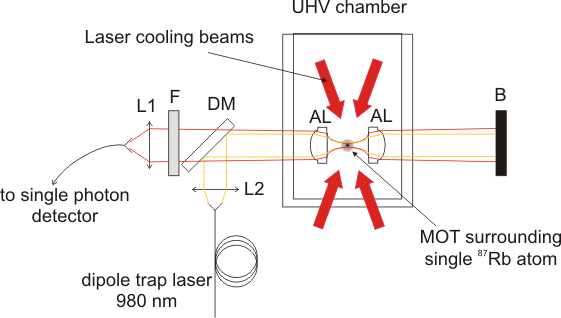
B - beam block, AL - aspheric lens, L1 - lens for collecting single atom fluorescence, L2 - lens for dipole trap laser collimation, F - filters, DM - dichoric mirror.
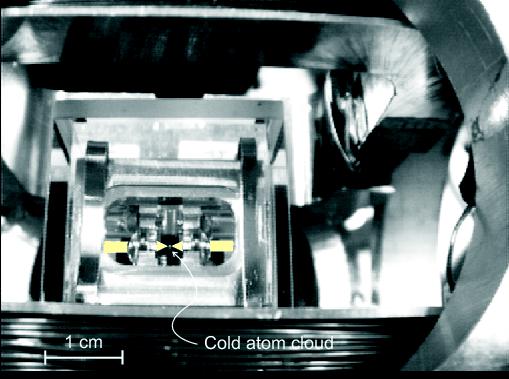
The picture above shows a cloud of cold 87Rubidium atoms
trapped confined in the MOT - the whitish dot in between the two lens.
A dipole trap beam (depicted in the setup as a yellow trace) is
focussed into the cloud to trap a single atom.
Signature of a single atom
The manifestation of a single atom in the trap is an anti-bunching effect in the atomic fluorescence. It is revealed in the dip in the histogram of time difference between two photodetection events observed when the atomic fluorescence is coupled to single photon detectors in a Hanbury-Brown-Twiss configuration.
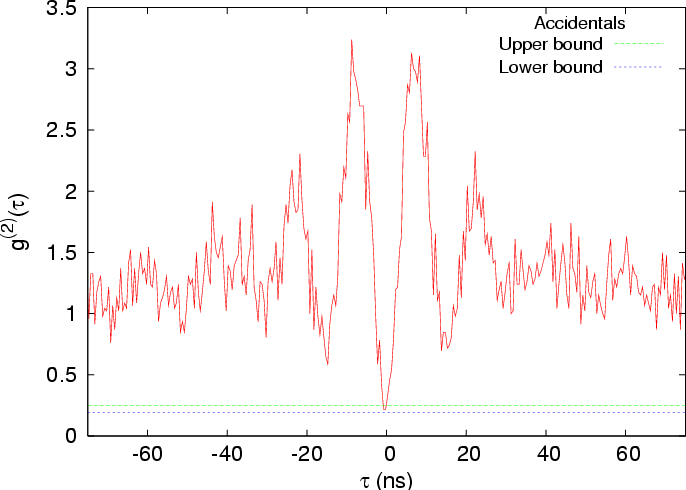
Our measurement reveals clearly anti-bunching for zero time delay, after taking into account for the noise caused by accidental pair events due to detector dark counts and ambient scattering. This clearly proves that we have a single atom in the observation region of our two detectors.
Reference:
[1] N. Schlosser, G.
Reymond, P. Grangier, Phys. Rev. Lett. 89,
023005 (2002)
[2] N. Schlosser, G. Reymond,
I.E. Protsenko, and P. Grangier, Nature 411, 1024 (2001)
[3] M. Weber, et al., Phys. Rev. A 73,
043406 (2006)